The crossover point, at your opponent's playing elbow, is the hardest place on the table to return from. Learn how to find it, attack it and follow up wide, step by step.
Diagrams show the table from above, you on the left. Solid gold lines are your shots, dashed lines your opponent’s. Tap any step to enlarge it.Attack the crossover point, step by step
The animation plays the whole sequence; the frames below break it into single shots.

Why this pattern wins points
Every player has a moment of indecision for a ball aimed at the playing elbow or hip, where forehand and backhand meet. That hesitation costs time, and a late return is usually short of pace and placement. The point is rarely won by the ball to the elbow; it is won by the next ball, played wide to the side they have just moved away from.
Key points
- The crossover point is roughly at the elbow or hip of their playing arm, where they must decide between forehand and backhand.
- Aim at the player, not at the middle of the table. If they stand in their backhand corner, their elbow is there too.
- A ball to the elbow rarely wins outright. It forces a late, cramped return, and the next ball goes wide to the open side.
- It works with every shot: serves, pushes, blocks and loops.
Common mistake
Aiming at the centre line of the table. Against a player standing off-centre that ball lands straight on their stronger wing.Common questions
What is the crossover point in table tennis?
It is the spot, roughly at the elbow or hip of the playing arm, where a player has to decide between forehand and backhand. Balls aimed there produce late, cramped returns.
Where is the crossover point on a left-hander?
On the other side: at their left elbow or hip. Aim at the player's actual position and playing arm, not at a fixed spot on the table.
Related strategies
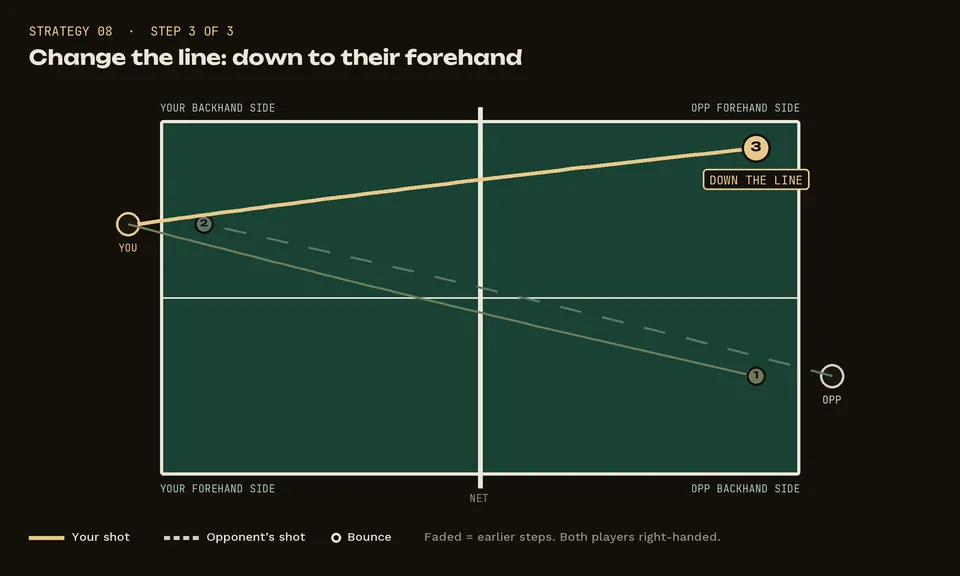
Switch the line
You are in a cross-court rally, backhand to backhand or forehand to forehand, and your opponent has settled into it.
Open strategy →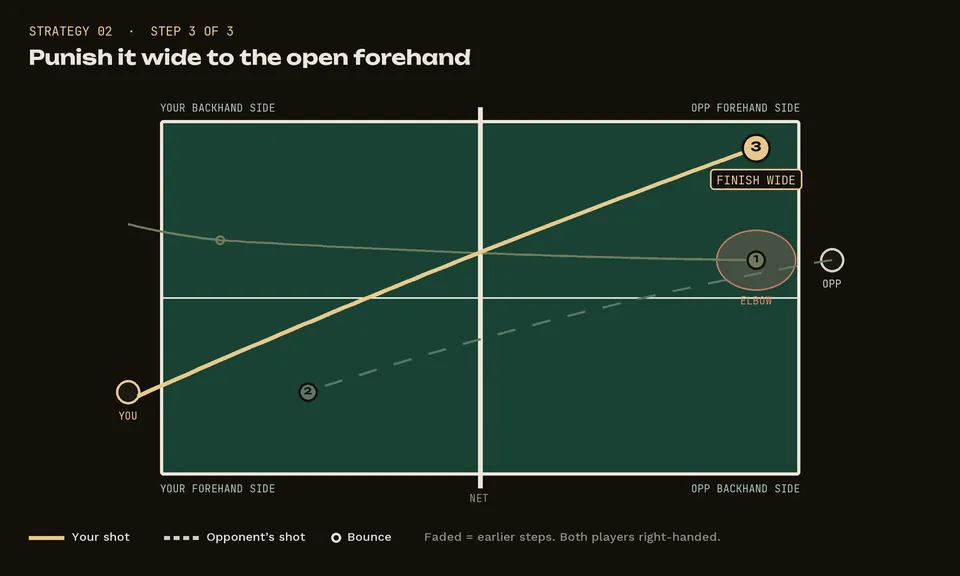
Fast long serve to the elbow
Your opponent starts leaning over the table waiting for short serves, or you need a change of rhythm at a big point.
Open strategy →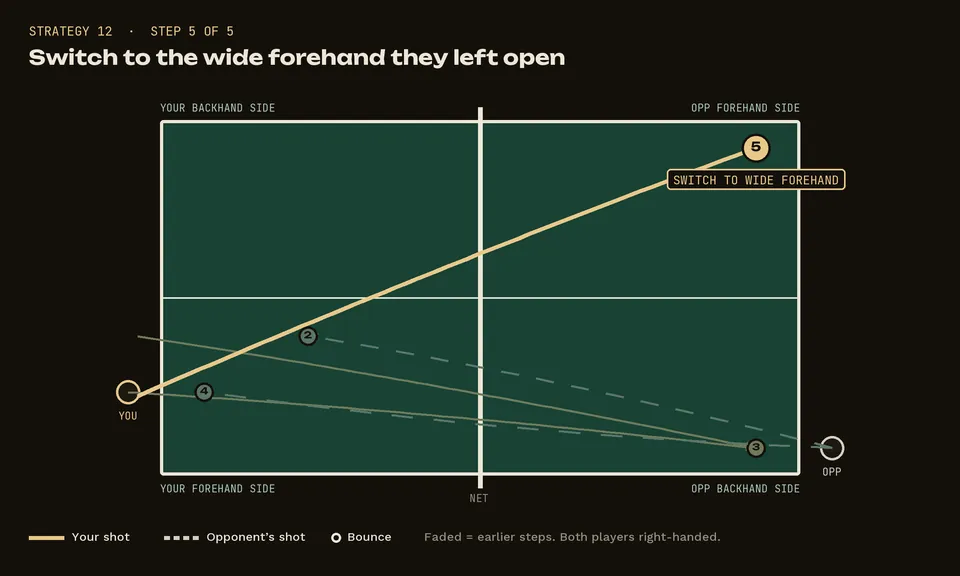
Attack a weak backhand
One of your opponent's wings, often the backhand, is clearly weaker or only returns the ball safely.
Open strategy →Match your setup to your game
Tell the AI setup finder how you play, or compare every Loki rubber on speed, spin and control, and build a bat that suits the patterns you use most.