Super Aryl Carbon is Loki’s stiffest outer-carbon weave, built into a single flagship blade for counter-loopers who refuse to give up table position.
What ‘Super’ changes versus standard Aryl Carbon
Standard Aryl Carbon balances speed against touch by letting the outer composite layer flex slightly on contact. Super Aryl Carbon increases fibre density per square centimetre in the same outer position, which resists that flex — the blade face stays rigid under a fast counter-hit instead of absorbing some of the impact, so more of the incoming and outgoing energy shows up as ball speed rather than blade deformation.
That calibration favours a specific style: players who stay close to the table and counter-loop against incoming topspin rather than stepping back to create their own swing. The wider sweet spot that comes from a stiffer, more uniform panel also means off-centre hits lose less pace than on a softer outer layer.
The one Loki blade built on Super Aryl Carbon
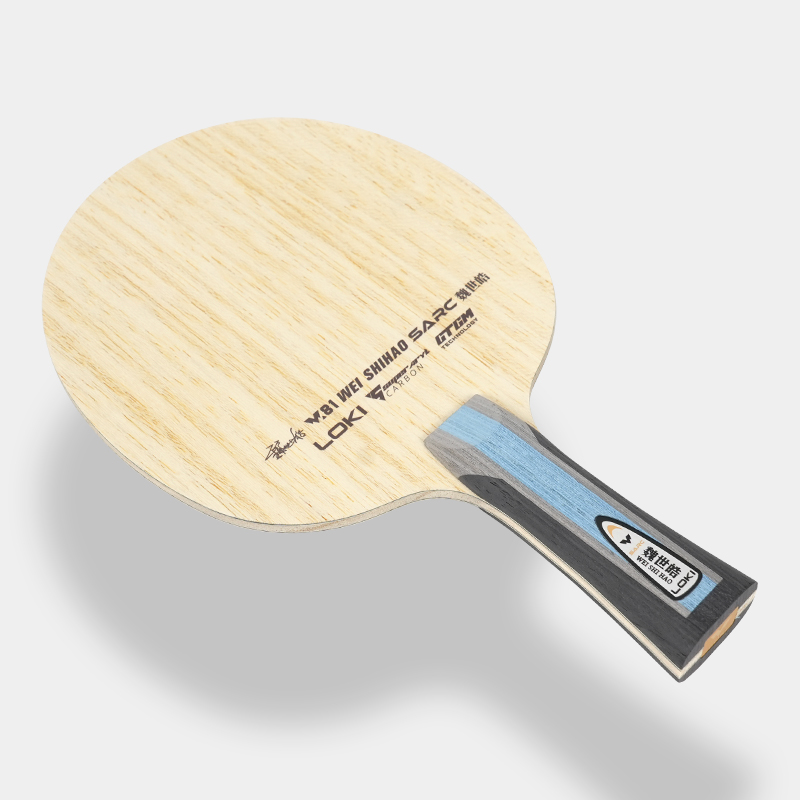
Loki W81 Wei Shihao SARC
- TypeOFF+
- Layers5W + 2 SARC
- Weight89g
- Speed / Control13.8 / 11.9
Common questions
Why does Loki only offer Super Aryl Carbon on one blade?
It is a specialist, stiffer variant of standard Aryl Carbon aimed at close-to-table counter-loopers specifically, rather than a general upgrade over the standard ARC blades that make up the bulk of the outer-carbon range.
Is Super Aryl Carbon faster than standard Aryl Carbon?
Loki’s own figures put it slightly ahead on Speed (13.8 versus the W81 Wei Shihao ARC’s 13.0) and slightly behind on Control (11.9 versus 12.0) on the manufacturer 1–15 scale — a small but real shift toward pace over margin for error.
Is the W81 Wei Shihao SARC legal for Table Tennis England and ITTF events?
Yes. It keeps 5 full wood plies either side of the 2 thin composite plies, meeting the ITTF construction rule for legal blades.
Related composite fibre guides
Build a bat around the Wei Shihao SARC
Match it with two rubbers in the Racket Configurator, or compare it directly with the standard ARC build.