Loki vs Butterfly blades: UK price & construction comparison
Butterfly’s blade range spans outer-carbon attackers, inner-carbon loopers and pure-wood classics. This guide maps Loki’s blade range against Butterfly’s closest equivalents by carbon placement and construction, using the same curated pairings that power our Shop by Comparison tool — not a claim that any pairing performs identically.
Butterfly prices verified via teessport.com, 14 September 2026 (inc-VAT offer prices)Three blade architectures, explained
Direct & explosive
Composite plies sit immediately under the thin outer face veneer, so the ball meets stiff carbon almost on contact. Rebound is fast and linear — good for counter-driving and active blocking close to the table.
Extended dwell
Composite plies sit against the core, cushioned by two wood plies. The ball compresses further into the blade before the carbon kicks in, which is what gives inner-carbon blades their reputation for heavier topspin with a softer touch on short game.
Pure tactile feedback
No stiff synthetic fibre, or a soft fibre like GNF that behaves closer to wood than carbon. Relies on the natural flex of the veneers for touch and control — the traditional choice for stroke development.
Butterfly vs Loki blade matrix
Pairings sourced from Loki’s own curated brand-comparison mapping, the same data used by the Shop by Comparison tool and the top-50 combinations page.
| Category | Butterfly | Butterfly price | Loki alternative | Loki construction | Loki price |
|---|---|---|---|---|---|
| Outer ALC attacker | Timo Boll ALC | £169.99 | Liang Jingkun ARC | 5W + 2 Outer Aryl Carbon, OFF+Speed 13.5 • Control 11.8 | £148.99 |
| Inner ALC looper | Innerforce Layer ALC | £149.99 | W81 Wei Shihao ADC | 5W + 2 Inner Aramid Carbon, OFF+Speed 13.2 • Control 12.5 | £79.99 |
| Super-fibre power blade | Fan Zhendong Super ALC | £209.99 | W81 Wei Shihao SARC | 5W + 2 Super Aryl Carbon, OFF+ | £99.99 |
| Prestige signature outer ALC | Zhang Jike ALC | —not currently listed at Tees Sport | Yuan Licen ARC | 5W + 2 Outer Aryl Carbon, OFF+Speed 13.2 • Control 12.1 | £132.99 |
| Defensive/all-round inner fibre | Diode V | £79.99 | Hu Dongshen X | 5W + 2 Inner Aramid Carbon-Light, OFF+Speed 12 • Control 13.5 | £99.99 |
| Composite carbon fibre (CAF) | Timo Boll CAF | £99.99 | Kirin K1 | Inner GNF Fiber, OFF+Speed 10.5 • Control 13.5 | £16.99 |
| All-wood classic | Michael Maze (OFF) | —not currently listed at Tees Sport | Kirin K7 | Wood Only, OFF+Speed 12.6 • Control 11.8 | £29.99 |
| 5-ply accessible classic | Primorac (OFF−) | £45.99 | Kirin K3 | Inner GNF Fiber, OFF+Speed 11.5 • Control 12 | £19.99 |
Loki figures are manufacturer specification from Loki’s 2026 catalogue (Speed/Control on a 1–15 scale). Kirin K1 and Kirin K3 both use a GNF Fiber composite rather than pure wood, so treat those two rows as closest accessible price tier, not identical construction to the Butterfly all-wood benchmark.
Featured Loki blades from the matrix
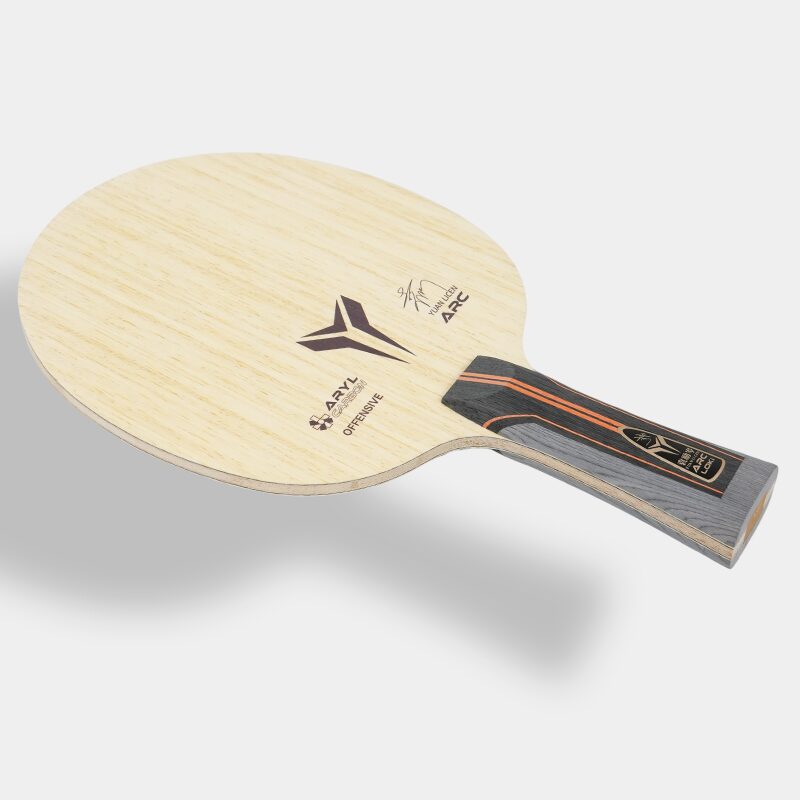
Loki Yuan Licen ARC
Benchmark: Butterfly Zhang Jike ALC (not currently listed at Tees Sport)
- Construction5W + 2 Outer Aryl Carbon
- Blade typeOFF+
- Speed / Control13.2 / 12.1
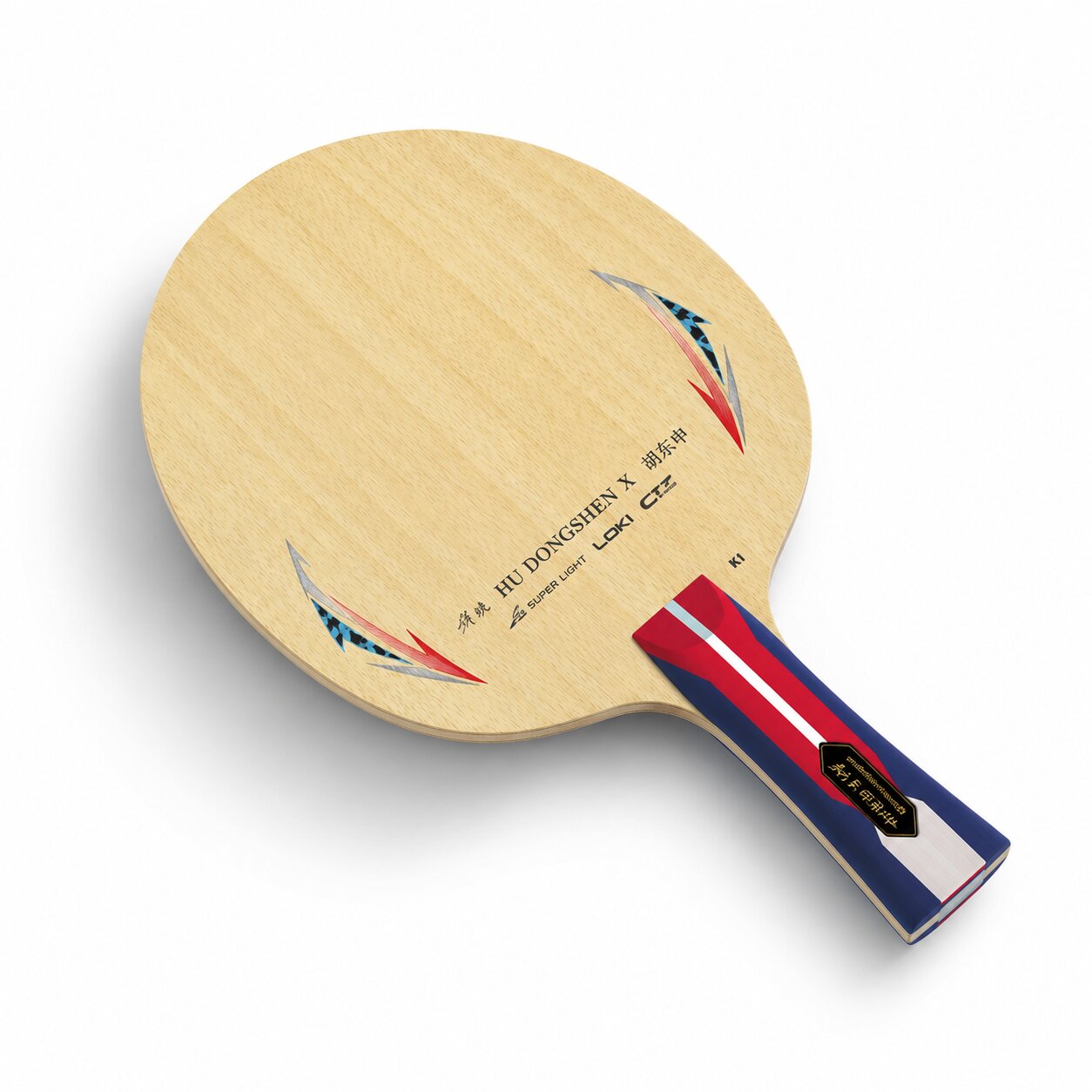
Loki Hu Dongshen X
Benchmark: Butterfly Diode V (£79.99)
- Construction5W + 2 Inner Aramid Carbon-Light
- Blade typeOFF+
- Speed / Control12 / 13.5

Loki Kirin K7
Benchmark: Butterfly Michael Maze (not currently listed at Tees Sport)
- ConstructionWood Only, no composite
- Blade typeOFF+
- Speed / Control12.6 / 11.8
Recommended rubber pairings for each architecture
A blade needs two rubbers. These pairings follow the manufacturer’s own construction logic — a tacky/tensor split for outer-carbon speed, a tensor pair for inner-carbon dwell.
Liang Jingkun ARC + Arthur China / Arthur Diamond
Crisp outer-carbon rebound paired with a tacky forehand for spin and a controllable tensor backhand.
W81 ADC + Arthur Europe / Kirin K5
Extended dwell for heavier topspin, with an all-round tensor forehand and a controllable backhand.
Kirin K7 + 2× Kirin K3 rubber
Pure-wood feedback for stroke development, paired with a matched tensor on both wings.
Common questions
Are Loki composite blades legal under ITTF racket regulations?
Yes. ITTF rule 2.4.2 requires at least 85% of the blade by thickness to be natural wood, with any composite layer no thicker than 7.5% of total thickness or 0.35mm, whichever is smaller. Every Loki composite blade in the range meets this construction rule and is legal for Table Tennis England competitions.
What’s the practical difference between outer and inner carbon?
Outer carbon sits just under the face veneer, giving a fast, direct rebound suited to close-to-table counter-driving. Inner carbon sits against the core under two wood plies, extending dwell time so the ball spends longer in contact with the blade — better suited to heavier topspin from mid-distance.
Why are Kirin K1 and K3 compared to all-wood Butterfly blades if they use GNF Fiber?
They’re the closest Loki blades in price and player level to Butterfly’s classic 5-ply models, not an identical-construction match. We’ve noted the difference directly in the table so the comparison stays honest.
Where can I see the rubber side of this comparison?
See the main Loki vs Butterfly guide for rubber-to-rubber pairings and full setup pricing.
Build a blade-and-rubber setup
Pick any blade above and two rubbers in the Racket Configurator to see a live total before you buy.